
Six years of terror laws is six years too much: Junk Terror Laws!


Six years after the enactment of the Anti-Terrorism Act of 2020 (ATA), the law has proven to be exactly what Indigenous Peoples and human rights defenders warned it would become: a weapon of state terror used to silence dissent, criminalize legitimate advocacy, and intensify attacks against Indigenous communities defending their lands, rights, and self-determination.
The Anti-Terror Law has emboldened the state to commit grave human rights violations under the guise of counterterrorism. Its vague and overbroad definition of terrorism has enabled authorities to target Indigenous leaders, environmental defenders, development workers, and ordinary community members whose only "crime" is asserting their collective rights.
Among the first victims of the Anti-Terror Law were Ayta farmers Japer Gurung and Junior Ramos of San Marcelino, Zambales, who were arrested in August 2020, tortured, forced to confess to crimes they did not commit, and falsely accused through the planting of firearms and explosives. Their case exposed how the law serves as legal cover for fabrication of charges and abuse by state forces.
In 2023, four leaders of the Cordillera Peoples Alliance—Windel Bolinget, Stephen Tauli, Sarah Abellon-Alikes, and Jennifer Awingan—were arbitrarily designated as terrorists by the Anti-Terrorism Council. Their terrorist designation resulted in the freezing of their assets and further endangered their work defending Indigenous Peoples' rights in the Cordillera. Just last month, the Baguio Regional Trial Court denied the leaders’ petition that challenged this baseless designation.
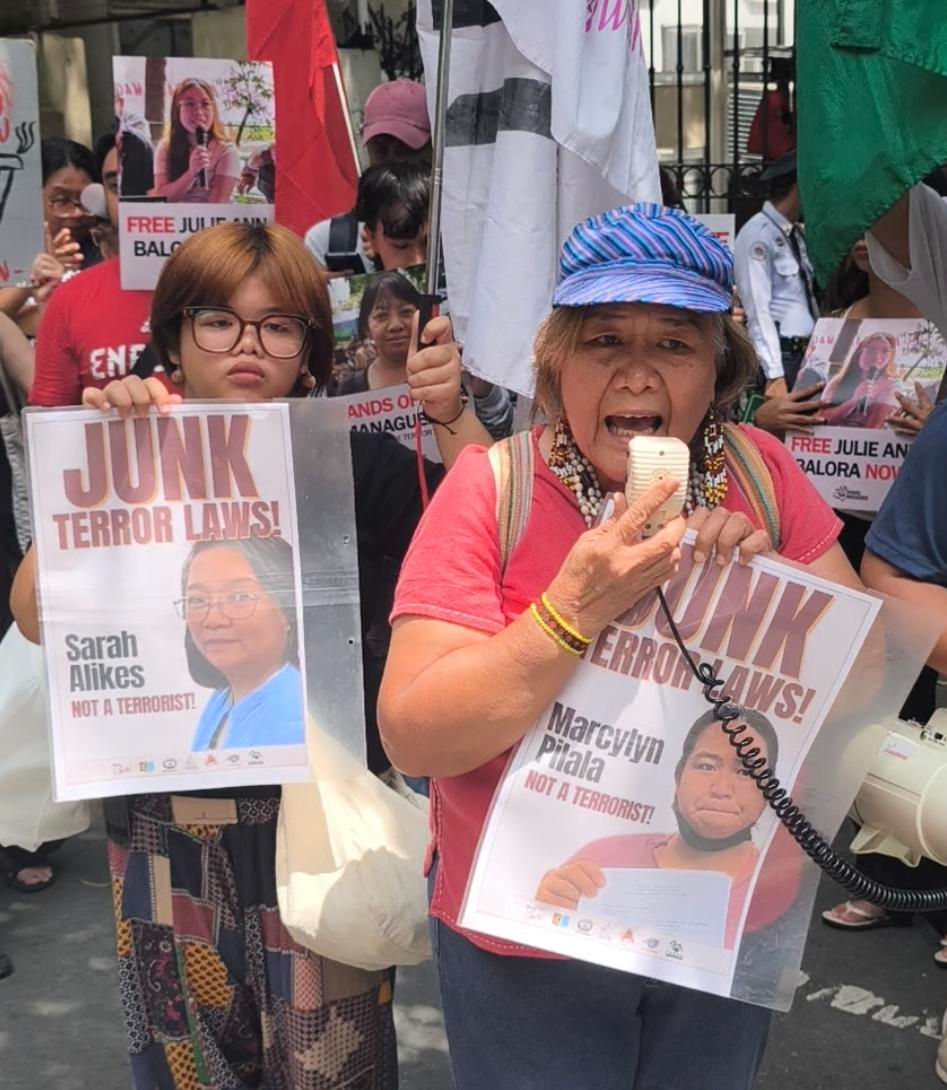
Beyond the Anti-Terror Law itself, related laws such as the Terrorism Financing Prevention and Suppression Act of 2012 (TFPSA) have likewise been weaponized against Indigenous Peoples and advocates such as Marcylyn Pilala, Mike Cabangon, and political prisoners Emilio Gabales III and Aldeem Yañez. Under the ATA, ordinary humanitarian and livelihood activities are maliciously construed as terrorism-related offenses.
These attacks do not occur in isolation. They form part of a broader pattern of militarization, red-tagging, judicial harassment, and political repression aimed at clearing the way for destructive mining operations, energy projects, plantations, dams, and other large-scale development projects that encroach upon Indigenous ancestral lands. As Indigenous communities continue to defend their territories against plunder, the state increasingly relies on terror laws to suppress resistance rather than address the roots of armed conflict.
Six years later, the Anti-Terror Law has never brought genuine peace or security to Indigenous communities. Instead, it has institutionalized fear, normalized impunity, and further shrunk democratic spaces for those speaking out against human rights violations and environmental destruction.

KATRIBU reiterates its demand to immediately repeal the Anti-Terrorism Act and all terror laws that facilitate the criminalization of dissent. We likewise call on the Supreme Court to declare the law unconstitutional and hold accountable those responsible for its widespread abuse. Both the Duterte and Marcos Jr, regimes should be held accountable for its crimes against the people. ### Reference:
Funa-ay Claver
Secretary-General
KATRIBU Kalipunan ng Katutubong Mamamayan ng Pilipinas


Comments